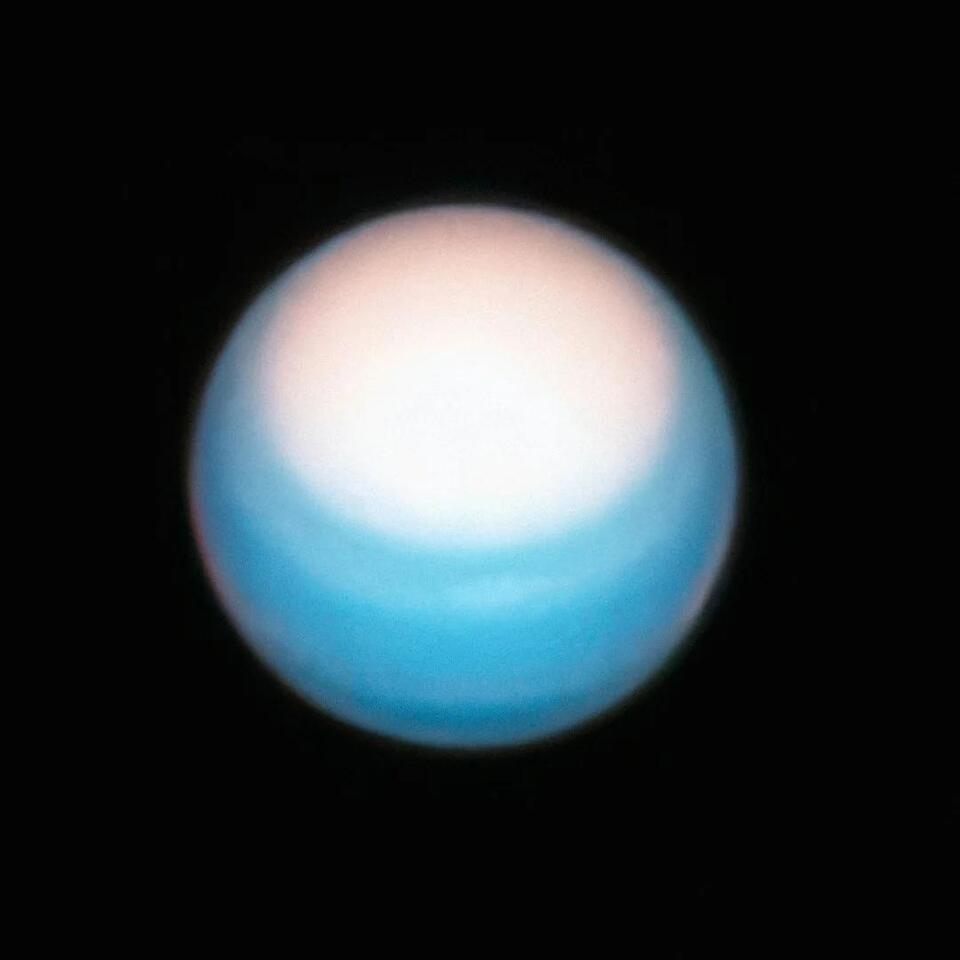
Decoding Uranus' Strange Auroras: Webb's New 3D Atmosphere Map Unveiled
Uranus, the enigmatic ice giant, has long presented a challenge to astronomers. Tilted on its side, shrouded in a hazy, frigid atmosphere, it offers glimpses of a world vastly different from our own. Among its many mysteries are its auroras – elusive, complex light shows that dance high above its clouds. For decades, our understanding of these phenomena has been limited by the sheer distance and the lack of detailed observational data. However, a monumental breakthrough has arrived, thanks to the unparalleled capabilities of the James Webb Space Telescope (JWST). With Webb's advanced instruments, an international team of astronomers has achieved a historic first: mapping the vertical structure of Uranus' upper atmosphere in three dimensions, providing an unprecedented
Uranus auroras map that decodes their "strange" nature.
This groundbreaking research, utilizing Webb's Near Infrared Spectrograph (NIRSpec) instrument, offers the most detailed portrait yet of where Uranus' auroras form. It reveals crucial insights into how temperature and charged particles vary with altitude across the planet, shedding light on the intricate interplay between its atmosphere and its unusually tilted magnetic field. More than just a pretty light show, these auroras are a window into the fundamental processes governing energy distribution within ice-giant planets, offering implications that reach far beyond our solar system.
What Makes Uranus' Auroras So Unique? A Cosmic Anomaly
To understand why Uranus' auroras are considered "strange," we must first appreciate the planet's peculiar orientation and magnetic field. Unlike Earth, which spins relatively upright and has a magnetic field largely aligned with its rotational axis, Uranus is a cosmic rebel. It rotates on its side, meaning its poles experience extreme seasonal variations, with each pole enduring decades of continuous sunlight followed by decades of darkness.
A Planet on its Side: The Tilted Magnetic Field's Influence
Compounding this axial tilt is its highly unusual magnetic field. Uranus' magnetic field is not only drastically offset from its physical center but also tilted by a staggering 59 degrees relative to its rotational axis. Imagine a magnet inside the planet that's both off-center and wildly askew. This complex geometry creates an incredibly dynamic and irregular magnetosphere.
On Earth, auroras (the Northern and Southern Lights) are typically confined to relatively stable oval regions around the magnetic poles. They are driven by charged particles from the solar wind interacting with our planet's well-aligned magnetic field, channeled towards the poles. On Uranus, however, this highly irregular magnetic field, combined with its unique rotation, leads to auroras that are far more complex and variable, making their formation mechanisms a long-standing puzzle for scientists. The incoming solar wind particles don't follow a simple path; instead, they are forced through a twisted, ever-changing magnetic labyrinth, resulting in aurora displays that defy easy categorization and have been incredibly difficult to model or observe in detail until now.
The Challenge of Observing Distant Worlds
Uranus, the seventh planet from the Sun, is truly a distant world. Compared to the close-up, high-resolution images we have of Mars, Jupiter, or Saturn, Uranus and its sibling Neptune have been relatively underexplored. Their vast distance makes them faint targets for ground-based telescopes and challenging for space probes, with only Voyager 2 having made a close flyby in 1986. This lack of detailed data has perpetuated many mysteries about these ice giants.
This is precisely where Webb's exceptional capabilities shine. Its massive mirrors and unparalleled sensitivity to infrared light allow it to pierce through cosmic distances and atmospheric hazes that obscure other telescopes. Webb has already demonstrated its prowess by capturing the clearest images of Neptune's rings and moons in decades (in 2022) and even discovering a new moon orbiting Uranus last year. Now, it has delivered an entirely new dimension of understanding by providing the first-ever vertical and 3D map of Uranus' upper atmosphere.
Webb's Breakthrough: A 3D View of Uranus' Upper Atmosphere
The recent observations, led by Paolo Tiranti of Northumbria University in the United Kingdom, involved Webb peering at Uranus for an impressive 17 hours—nearly a full planetary rotation. This extended observation period allowed the telescope to gather a wealth of data, creating a detailed atmospheric profile.
Mapping the Vertical Structure and Charged Particles
What the NIRSpec instrument revealed is revolutionary. For the first time, scientists have been able to map how temperature and the density of charged particles fluctuate across different altitudes in Uranus' ionosphere. The measurements show that temperatures peak between 3000 and 4000 kilometers above the clouds, reaching around 426 Kelvin (or approximately 150°C), while ion densities reach their maximum around 1000 kilometers.
Crucially, this new
Webb Solves Uranus Aurora Mystery & Reveals Cooling Atmosphere mapping shows clear longitudinal variations in these atmospheric properties. These variations are directly linked to the complex, tilted geometry of Uranus' magnetic field, confirming theoretical models that predicted such irregularities. This 3D perspective is vital because auroras are not flat phenomena; they extend vertically through the atmosphere. By understanding the layered structure, scientists can pinpoint the precise altitudes and conditions necessary for these strange auroras to ignite and glow, offering the most comprehensive blueprint of their formation zones ever achieved.
The Mystery of a Cooling Atmosphere
Beyond the auroras, the data also confirmed another intriguing aspect of Uranus' atmosphere: it continues to cool. Measurements indicate that the planet's upper atmosphere has been steadily cooling since the early 1990s. While the exact reasons for this long-term cooling trend are still under investigation, this observation adds another layer of complexity to our understanding of how ice giants regulate their internal heat and interact with their surroundings. Is it a long-term seasonal effect? Is it influenced by the planet's internal dynamics? These questions now have precise, modern data to guide future hypotheses.
Beyond Uranus: The Broader Impact of Ice Giant Research
The insights gained from Webb's new
Uranus auroras map extend far beyond this singular planet. Uranus and Neptune, as "ice giants," represent a distinct class of planets in our solar system, fundamentally different from the rocky inner planets (like Earth and Mars) and the gas giants (Jupiter and Saturn).
*
Understanding Planetary Atmospheres: Studying Uranus' atmosphere provides crucial data points for refining models of planetary atmospheric physics, especially for worlds dominated by hydrogen, helium, and methane ices.
*
Magnetic Fields and Planetary Dynamics: The peculiar nature of Uranus' magnetic field offers a natural laboratory for understanding how magnetic fields are generated in planetary interiors (the dynamo effect) and how they interact with stellar winds and influence atmospheric escape.
*
Exoplanetary Insights: Ice giants like Uranus are thought to be common types of planets across the galaxy. The more we learn about their composition, atmospheric dynamics, and unique phenomena like complex auroras, the better equipped we are to interpret observations of exoplanets in similar categories. Could these distant ice giants also harbor strange, tilted magnetic fields and complex aurora displays? Webb's findings on Uranus bring us closer to answering such questions.
This research underscores Webb's transformative power in planetary science. By providing unprecedented detail on a distant, enigmatic world, it not only answers long-standing questions but also opens up a host of new ones, propelling our quest to understand the universe and our place within it. The strange auroras of Uranus are no longer just a mystery; they are now a signpost guiding us toward deeper cosmic understanding.