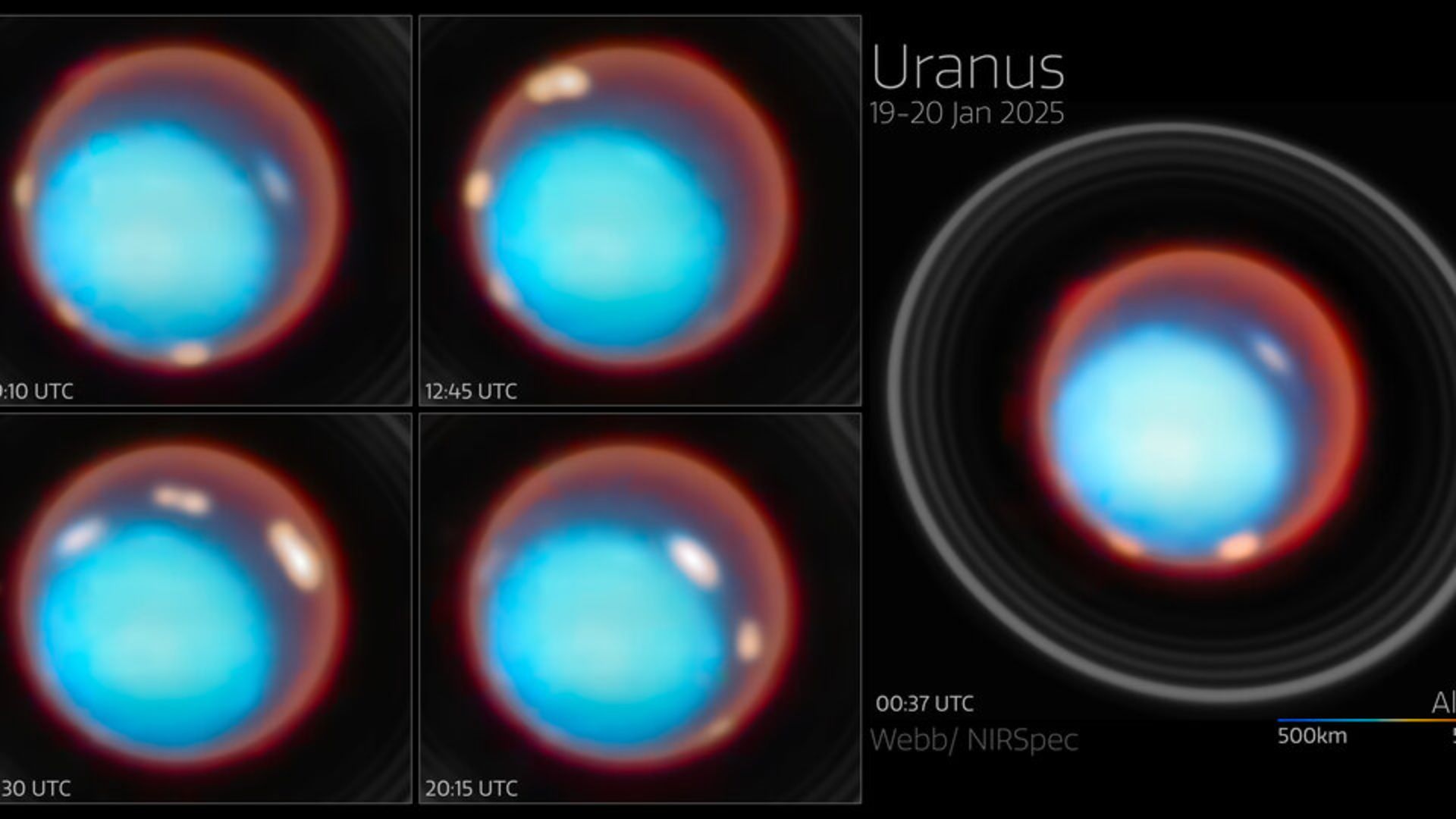
Webb Maps Uranus' Strange Auroras: Uncovering Formation Secrets
In the vast expanse of our solar system, Uranus, the enigmatic ice giant, has long remained shrouded in mystery. Distant and rarely observed in detail, its secrets have eluded astronomers for decades. However, thanks to the unparalleled capabilities of the James Webb Space Telescope (JWST), a new chapter in understanding this peculiar planet has begun. For the first time, an international team of astronomers has delivered a groundbreaking, three-dimensional Uranus auroras map, offering an unprecedented look into its upper atmosphere and the bizarre mechanisms behind its auroral displays.
This monumental achievement provides the most detailed portrait yet of where Uranus's auroras form, how they are influenced by its uniquely tilted magnetic field, and even reveals a surprising atmospheric cooling trend. It's a testament to Webb's power, offering a vital new window into how ice-giant planets distribute energy in their upper layers and challenging long-held assumptions about these distant worlds.
The Peculiar Allure of Uranus' Auroras
When most people think of auroras, they picture the mesmerizing Northern Lights on Earth – vibrant green and sometimes red curtains dancing across the polar skies. These celestial light shows occur when charged particles from the Sun collide with gases in our planet's atmosphere, channeled by Earth's relatively stable magnetic field.
Uranus, however, presents a far more complex and 'strange' scenario. Unlike Earth, whose rotational axis is only slightly tilted, Uranus spins almost completely on its side, with an axial tilt of nearly 98 degrees. Adding to this eccentricity, its magnetic field isn't aligned with its rotational axis, nor does it pass through the planet's center. Instead, it's tilted by about 59 degrees relative to the rotational axis and significantly offset from the planet's core. This bizarre combination creates a highly dynamic and convoluted magnetic environment, suggesting that Uranus' auroras would be unlike anything else observed in our solar system.
Before Webb, detailed observations of these auroras were incredibly difficult due to Uranus' immense distance and the faintness of the emissions. Previous glimpses hinted at their unusual nature, but a comprehensive understanding of their formation and behavior remained out of reach. The new Uranus auroras map changes everything, allowing scientists to pinpoint the regions where these cosmic light shows erupt with unprecedented precision.
Webb's Revolutionary Gaze: Building a 3D Atmospheric Map
The key to unlocking Uranus' atmospheric secrets lies with Webb's Near Infrared Spectrograph (NIRSpec instrument). For 17 continuous hours – nearly a full rotation of Uranus – Webb meticulously collected data, detecting the faint infrared glow from molecules high above the planet's clouds. This extended observation allowed astronomers to create the first-ever vertical and three-dimensional map of Uranus' upper atmosphere, revealing how temperature and charged particles vary with height and across the planet's longitudes.
As Paolo Tiranti of Northumbria University, who led the research, stated, "This is the first time we’ve been able to see Uranus’s upper atmosphere in three dimensions." This wasn't just a static snapshot; the 17-hour observation period provided a dynamic timelapse, capturing the planet's upper atmospheric structure as it rotated. The data revealed critical details:
- Temperature Peaks: Temperatures were found to peak between 3000 and 4000 kilometers above the clouds.
- Ion Density Maximums: Ion densities, crucial for aurora formation, reached their maximum around 1000 kilometers altitude.
- Longitudinal Variations: Both temperature and ion density showed clear variations across different longitudes, directly linked to the complex geometry of Uranus' magnetic field. This provides crucial evidence of how the offset and tilted magnetic field directly sculpts the planet's atmospheric conditions.
This unprecedented data allowed researchers to construct a detailed *Uranus auroras map*, showing not just where the auroras might be seen from above, but also their structural depth within the atmosphere.
Unveiling Formation Secrets and Atmospheric Surprises
The comprehensive *Uranus auroras map* has provided several astounding insights:
- Magnetic Field Dominance: The research conclusively demonstrates the profound influence of Uranus's unusually tilted and offset magnetic field on its auroras. Unlike Earth, where auroras are primarily confined to polar regions, Uranus's complex field likely steers charged particles in much more intricate patterns, leading to auroral displays that could appear in unexpected locations and configurations. Understanding this interaction is vital for modeling the magnetospheres of other ice giants and even exoplanets with similar eccentric fields.
- A Cooling Atmosphere: Perhaps one of the most surprising findings is that Uranus's upper atmosphere has been continually cooling since the early 1990s. The average temperature was measured at around 426 kelvins (150°C), but the observed cooling trend suggests a dynamic process at play. This sustained cooling could be related to atmospheric escape mechanisms or an internal redistribution of energy, offering profound clues about the planet's internal heat engine and its interaction with the upper atmosphere. This is a significant piece of the puzzle in understanding how ice giants, which radiate less internal heat than gas giants like Jupiter and Saturn, manage their energy balance.
- Energy Distribution Insights: By mapping the temperature and ion density vertically, the team gained critical insights into how energy is absorbed, transported, and radiated away in Uranus's upper layers. This knowledge is not just for Uranus; it helps planetary scientists refine models for the atmospheres of other ice giants like Neptune, and by extension, a growing number of exoplanets discovered to be Neptune-like or super-Earths.
The detailed *Uranus auroras map* derived from this data is more than just pretty pictures; it's a scientific Rosetta Stone for ice giant atmospheres. It allows scientists to compare theoretical models with real-world observations, pushing the boundaries of our understanding of planetary physics.
The Enduring Power of the James Webb Space Telescope
This achievement is just one example of the James Webb Space Telescope's transformative power. Prior to Webb, Uranus and Neptune were relatively "little-photographed" planets, mainly due to their extreme distance. Missions like Voyager 2 provided brief flybys, but long-term, detailed observation was a significant challenge. Webb's massive mirrors and exceptional infrared imaging capabilities have overcome this hurdle.
Beyond this *Uranus auroras map*, Webb has already delivered stunning images of Neptune's rings and moons in 2022, and even discovered a new moon orbiting Uranus last year. These observations underscore the telescope's critical role in exploring the outer reaches of our solar system, providing data that will fuel research for decades to come. Understanding these distant planets helps us piece together the puzzle of solar system formation and evolution, and provides valuable comparative data for the thousands of exoplanets we are now discovering.
Conclusion: A New Era for Ice Giant Exploration
The James Webb Space Telescope's groundbreaking Uranus auroras map represents a monumental leap forward in our understanding of this distant ice giant. By providing the first-ever three-dimensional view of its upper atmosphere, Webb has not only unveiled the intricate mechanics behind Uranus's strange auroras but also revealed a surprising atmospheric cooling trend and crucial insights into energy distribution. This detailed portrait, achieved through 17 hours of meticulous observation with the NIRSpec instrument, fundamentally reshapes our knowledge of Uranus's magnetic field and atmospheric processes. It highlights the dynamic and complex nature of ice giants, opening new avenues for research into planetary formation and the broader cosmos. As Webb continues its mission, we can anticipate further astonishing revelations, paving the way for a new era of ice giant exploration and deepening our appreciation for the diverse wonders of our solar system.